Before smartphones, before apps, before AI chatbots, and long before kids were asking whether ChatGPT could do their homework, there was a box connected to the family television, a joystick with one button, and a generation of kids discovering that technology was not just something you watched. It was something you controlled.
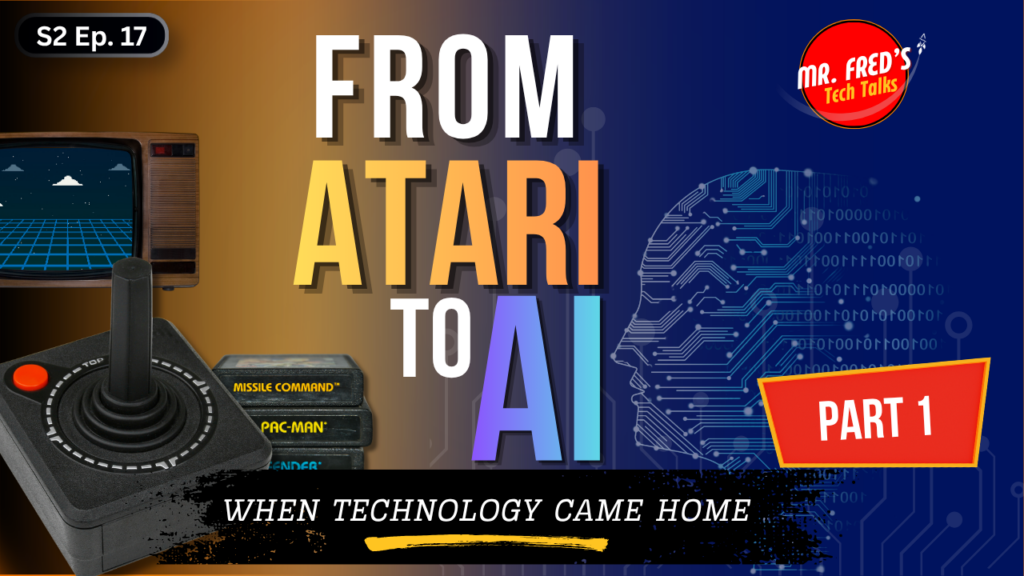
This is Part 1 of From Atari to AI, a new series on Mr. Fred’s Tech Talks that traces the full arc of technology from the living room to the age of artificial intelligence. And it starts exactly where it should: at a Kmart toy aisle, peering through glass at Atari cartridges.
In This Episode
In this episode, Mr. Fred covers:
- how home gaming systems like the Atari 2600 changed the relationship families had with technology
- what made arcade culture at places like Aladdin’s Castle a genuine social and learning experience
- why games like Pac-Man and Galaga were early examples of pattern recognition, strategy, and decision-making
- how childhood curiosity about technology connects directly to coding, problem-solving, and eventually AI
- why every generation has a gateway technology, and why that still matters today
- the Tech Challenge: The First Tech Wow, a conversation starter for families, classrooms, and anyone who remembers the moment technology first grabbed their imagination
This episode is designed for parents, teachers, students, and anyone who wants to understand how we got here. No technical background required.
The Big Idea
Every generation has a gateway technology.
For many people who grew up in the late 1970s and 1980s, it was the Atari 2600. For some it was Nintendo. For others it was the first family computer, the internet, or Minecraft. Today, for many kids, it may be AI.
The tool changes. The curiosity is the constant.
When kids are drawn to technology, the most important questions are not just about screen time. They are also: What are they curious about? What are they trying to make? What patterns are they noticing? What story are they creating? And what skill can grow from that interest?
That shift from button pusher to problem solver, from consumer to creator, is why GetMeCoding exists. And for Mr. Fred, that shift started with Atari cartridges behind glass at a Kmart and the glow of an arcade cabinet.
The Atari 2600 and the Living Room Revolution
The Atari 2600 launched in 1977 and did something genuinely revolutionary for its time. It was a box you plugged into your television that played games from swappable cartridges. You could own the game. You could take it home. You could play for free, any time, without feeding quarters into a machine.
In a world without internet, streaming, smartphones, or app stores, that idea was enormous. The television was the center of the living room, and suddenly there was a device that made it interactive. Families gathered around it. Kids played for hours. And for some of them, a quiet question started forming: how does this work?
That question, Mr. Fred argues, is where everything starts. It is the question that takes a kid from playing a game to building one. From curiosity to code. From Atari to AI.
The Arcade Was Still Magic
Even as home gaming took hold, the arcade was doing something the living room could not quite replicate: bringing people together around shared technology in a public space.
Places like Aladdin’s Castle, a mall-based arcade chain that reached roughly 450 locations across the country at its peak in 1983, were genuinely electric environments. You heard them before you saw them. The bleeps, the bloops, the thunk of joysticks, the glow of dozens of screens. And then there was the social dimension.
If someone was good, people gathered. The older kid who could clear board after board on Pac-Man or Galaga without losing a life was a local celebrity. You watched with genuine awe. And somewhere in the back of your mind, you were trying to figure out the pattern.
That is learning. That is strategy and pattern recognition and problem-solving. Nobody called it computational thinking at the time. But it was there.
Why This Matters Now
The connection between early gaming and modern technology is not just nostalgia. It is a real through-line.
The curiosity a kid developed watching an arcade master navigate a Galaga board is the same curiosity that leads a student to ask how an algorithm works, or wonder how a recommendation engine knows what to show next, or decide they want to build something of their own.
Understanding where technology came from helps us understand where it is going. And it helps parents and teachers recognize that when a kid is deeply engaged with technology, something worth paying attention to may already be growing.
Tech Challenge: The First Tech Wow
This week’s Tech Challenge is called The First Tech Wow.
Find someone from a different generation, a child, a parent, a grandparent, a friend, or a coworker, and ask them one simple question: what was the first piece of technology that made you say “wow”? Not the most expensive or the newest. The first one that really grabbed your imagination.
Then ask two follow-up questions. What did it let you do that you could not do before? And what did it make you curious about?
For a bonus challenge, build a three-part timeline together. The technology that excited the older person. The technology that excites the younger person today. And one technology you think people will still be talking about twenty years from now.
This is a great dinner table conversation, a classroom discussion, or a long car ride activity. If you get a great story out of it, share it in the GetMeCoding Facebook community. These stories matter. They remind us that behind every big technology shift are real people, real memories, and real moments of discovery.
Keep Exploring
- Season 2, Episode 16: Memorial Day Is Different
- Season 2, Episode 13: The 2026 Coding Toy Guide
- Explore all episodes of Mr. Fred’s Tech Talks
- Visit GetMeCoding.com for resources, blog posts, and coding ideas
Listen to the Episode
Be sure to tune in to this episode of Mr. Fred’s Tech Talks and share it with someone who grew up with early video games, or someone raising a kid who is just starting to wonder how technology works.
Keep learning. Keep questioning. And keep building.