
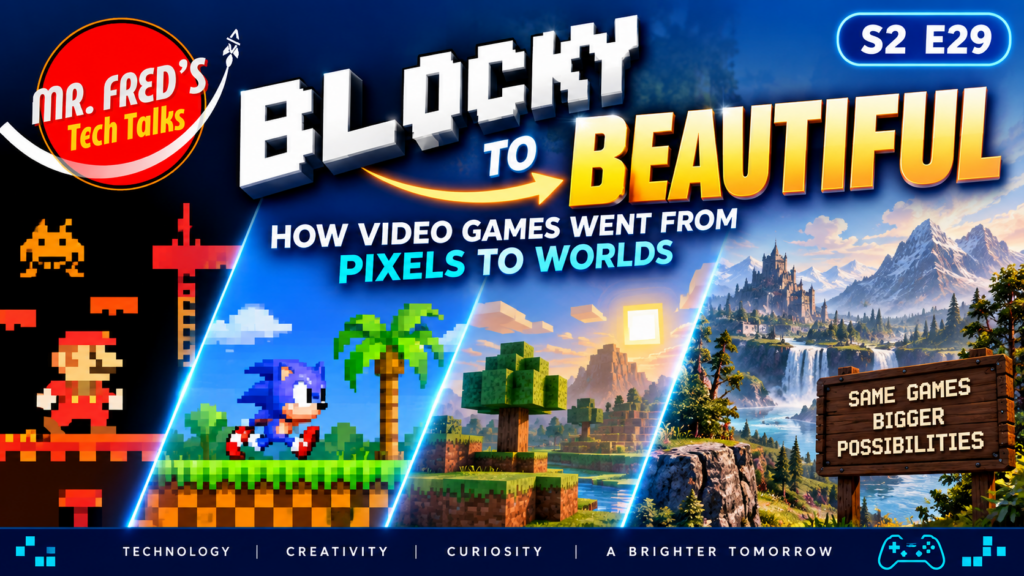
How did video games go from a handful of colored blocks to enormous 3D worlds with realistic lighting, reflections, and shadows? In this episode of Mr. Fred’s Tech Talks, I break down the evolution of video game graphics in plain English, from pixels and sprites to polygons, GPUs, textures, and ray tracing. But there’s a bigger lesson hiding inside the technology: better graphics do not automatically make a better game.
Early game designers had very little memory and processing power, so every pixel mattered. Those limitations forced them to become remarkably creative. Today, games can look almost photorealistic, while others, like Minecraft and modern pixel-art games, intentionally embrace a blocky style.
What You’ll Learn
- What a pixel actually is
- Why early Atari-era games looked blocky
- How sprites evolved into 3D models
- What polygons and GPUs do
- How textures and lighting make games look realistic
- What ray tracing means in simple terms
- Why some modern games intentionally avoid realism
- How constraints can actually encourage creativity
Why Were Old Video Games So Blocky?
Early video game systems had extremely limited memory and processing power compared with modern consoles, computers, and phones. Designers had to communicate characters, objects, and movement using very small numbers of pixels, shapes, and colors. That meant every visual choice mattered. Those limitations were not simply weaknesses. They became creative challenges. How Did Video Games Become 3D?
Modern games often build characters and environments from collections of small flat surfaces called polygons, usually triangles. Those 3D models are combined with textures, lighting, shadows, and other effects. A graphics processing unit, or GPU, performs huge numbers of calculations very quickly so the scene can continuously update while you play. Interestingly, that same ability to perform many calculations in parallel is one reason GPUs later became important for artificial intelligence.
Do Better Graphics Make Better Games?
Not necessarily.
Modern developers sometimes deliberately choose pixel art, block-based graphics, or other stylized designs even though much more realistic graphics are possible. That leads to one of the bigger ideas in this episode: Constraints can create creativity.
Having fewer tools, less memory, or fewer options can force designers and programmers to think differently about what really matters.
This Week’s Tech Challenge: The 8-Bit Challenge
Create an 8×8 grid, giving yourself only 64 squares.
Choose something recognizable, such as a dog, spaceship, tree, car, or video game character, and try to recreate it using only those squares.
Then show it to someone without telling them what it is.
Can they recognize it?
If not, debug the design and try again.
That’s very similar to the challenge early video game artists faced: deciding which tiny details were actually necessary for someone to understand what they were seeing.
Your Turn
What was the first video game that made you stop and think: “Wow…that looks amazing”?
Was it Atari? Super Mario Bros.? Mario 64? Minecraft? A modern sports game? I’d love to hear your answer.
Listen to the full episode of Mr. Fred’s Tech Talks, and then come back to GetMeCoding.com for more approachable conversations about coding, AI, technology, creativity, and helping kids become creators instead of only consumers.