When was the last time you talked to someone who has actually lived it?
Not just read about it. Not just watched a tutorial. Someone who has written real software, built systems that tracked things in space, and then walked into a classroom to help the next generation figure it all out.
That is who we have in this episode.
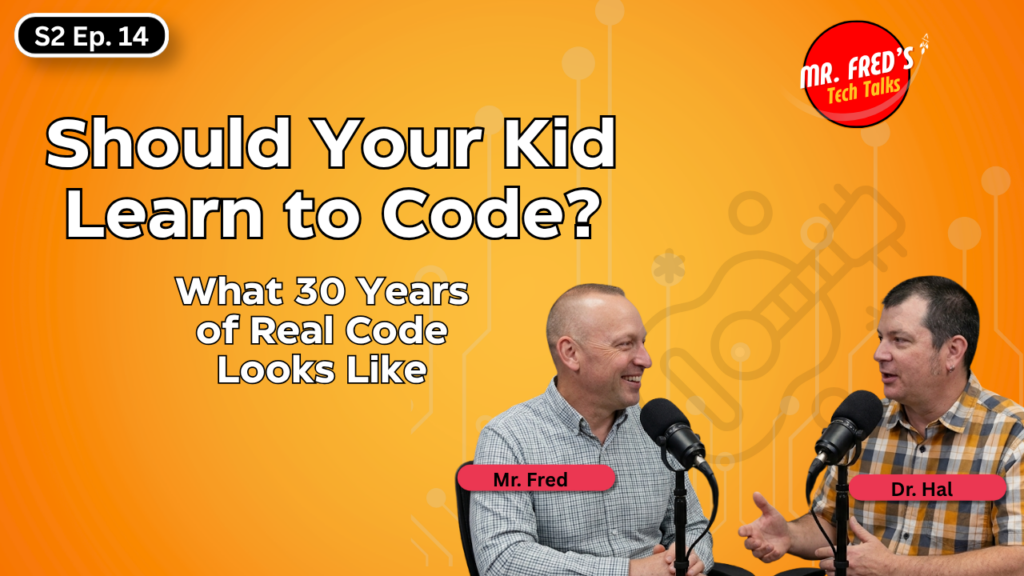
Dr. Hal Smith is a professor of Information Sciences and Technology, a former software developer at Raytheon, a mathematician by training, and yes, a ukulele player. He and Mr. Fred go way back as colleagues, and this conversation is exactly what it sounds like when two educators who genuinely love technology sit down and just talk.
This one runs longer than a typical episode. Every minute is worth it.
What You Will Learn
- Why learning to code is still worth it, even with AI in the picture
- What it actually feels like to learn programming for the first time, and why most students struggle at the start
- How real-world industry experience changes the way you teach
- What elegant code is, why it matters, and what we might lose as AI writes more of our software
- Why curiosity might be the most important skill in technology
- Practical advice for parents, educators, and young people who are wondering where to start
About Dr. Hal Smith
Dr. Hal Smith is a professor of Information Sciences and Technology with nearly three decades of teaching experience spanning graduate school, industry, and higher education. Before entering the classroom full-time, he spent years as a software developer at Raytheon, where he worked on ground-based radar systems, operating system abstraction layers, and missile guidance algorithms.
He is a mathematician by training, a tinkerer by nature, and a ukulele player by choice. He currently teaches programming, computer science, and discrete mathematics, and he still writes code for fun every chance he gets.
Highlights From This Episode
The Cub Scout Field Trip That Started Everything
Dr. Hal’s origin story begins at a power facility in upstate New York, where a computer used to control the region’s electricity also happened to play Hangman. That moment sparked a lifelong obsession with what computers could do.
The Timex Sinclair Connection
Both Mr. Fred and Dr. Hal started on a Timex Sinclair, complete with its membrane keyboard and cassette-based loading. Dr. Hal still owns his. He brings it to class every first semester to show students where it all began.
What Raytheon Taught Him That No Textbook Could
Dr. Hal shares what it was like to write real production software for the first time, including building a globe display for a radar tracker, creating an operating system abstraction layer, and the time he had to debug an actual compiler. These are the kinds of problems you simply cannot recreate in a classroom.
The Saxophone Analogy
When students walk into a first-semester programming class, Dr. Hal reminds them: imagine this is Intro to Saxophone. You have never held the instrument. You do not know how to read music. Give yourself some grace. This is going to take time and practice.
Should Your Kid Learn to Code?
Dr. Hal’s answer is yes, and the reason he gives is one of the best we have heard. Learning to code is like learning an instrument. Once you have the skill, you can participate in a whole new kind of conversation. You can collaborate. You can build. You can contribute.
The Elegance Question
One of the richest parts of this conversation centers on elegant code, what it is, why it matters, and what we might be giving up as AI takes over more of the writing. Dr. Hal draws a fascinating parallel to the Gutenberg printing press and the illuminated manuscripts that came before it. We gained something enormous. But did we lose something too?
Arduinos, Tinkering, and the Hardware Connection
Dr. Hal picked up his first Arduino kit just a few months before this recording and immediately fell in love with it. Mr. Fred shares how he brought hardware tinkering into his own classroom and why that connection between software and physical objects matters so much for young learners.
Advice for Educators
For teachers and professors trying to keep up with a world that will not slow down, Dr. Hal’s advice is simple: do not panic. Be skeptical of the hype. Find where AI can actually help you do your job better, and use it there. He shares a specific example from his own classroom using a Mancala game arena and AI-generated agents that is genuinely worth hearing.
Tech Challenge
This week’s challenge comes straight from Dr. Hal.
Look around you. Pick something that involves technology and ask: how does that actually work?
A traffic camera. A badge reader at a door. The algorithm that just recommended a song. Pick one. Start anywhere. Just get curious.
That is how it begins.
Resources and Links Mentioned
- GetMeCoding.com – Home base for the podcast, resources, and more
- 30 Days Lost in Space Kit – The beginner electronics kit Mr. Fred and Dr. Hal both recommend for curious kids and adults (Shop here)
- Tinkercad.com – Free browser-based tool for building and simulating Arduino circuits before you buy hardware
- Apollo Moon Landing Descent Code on GitHub – The actual code used to guide the lunar module, with readable comments that are both funny and fascinating
- Arduino Starter Kits – Search “Arduino starter kit” on Amazon for affordable entry points into hardware tinkering
Connect with GetMeCoding
🌐 Website: https://www.getmecoding.com 🎓 Courses: https://courses.getmecoding.com
Bring Mr. Fred to Your School, Workplace, or Event
If this conversation sparked something for you and you are planning an event this summer or fall, let’s connect.
Mr. Fred speaks on technology, AI, coding, and digital literacy in a way that is practical, warm, and built for everyday people — not just tech experts.
👉 Visit GetMeCoding.com to set up a call.
Share This Episode
If this conversation helped you, share it with:
- A parent who keeps wondering whether coding is worth it for their kid
- A teacher trying to figure out how to keep up with AI in the classroom
- A student who feels like they are too far behind to start
- A friend who has always been curious about how technology actually works
Keep learning. Keep questioning. And keep building.