The American Revolution should not have worked. A group of colonists armed with muskets, limited supplies, and no professional military infrastructure decided to take on the most powerful empire in the world. And they won. Part of the reason why comes down to something you use every single day without thinking about it: secret messages, coded communication, and what we now call encryption.
In this episode of Mr. Fred’s Tech Talks, we trace a direct line from Revolutionary War spy craft to the lock icon on your browser. It is a story about information, trust, and the idea that keeping messages safe is not a modern problem. It is a very old one.
In This Episode
In this episode, Mr. Fred covers:
- why the American Revolution was, at its core, an information problem
- the Culper Ring: George Washington’s real-life spy network operating inside British-occupied New York City
- how Revolutionary War spies used invisible ink, clothesline signals, and number codes to pass intelligence
- what a nomenclator is and why it worked
- the connection between colonial codebooks and modern encryption
- what plaintext, ciphertext, and encryption keys actually mean in plain language
- how the Caesar cipher works and why it matters as a starting point
- why encryption is not just about privacy, but also about trust and authenticity
- digital signatures explained without jargon
- the bigger debate about encryption, privacy, and government access
- a hands-on Tech Challenge you can do with your family, students, or class
This episode is designed for parents, teachers, students, and curious learners of all ages. No technical background required.
The Big Idea
Encryption is not a modern invention. It is an ancient idea: take readable information and scramble it so that only the intended recipient can unscramble it.
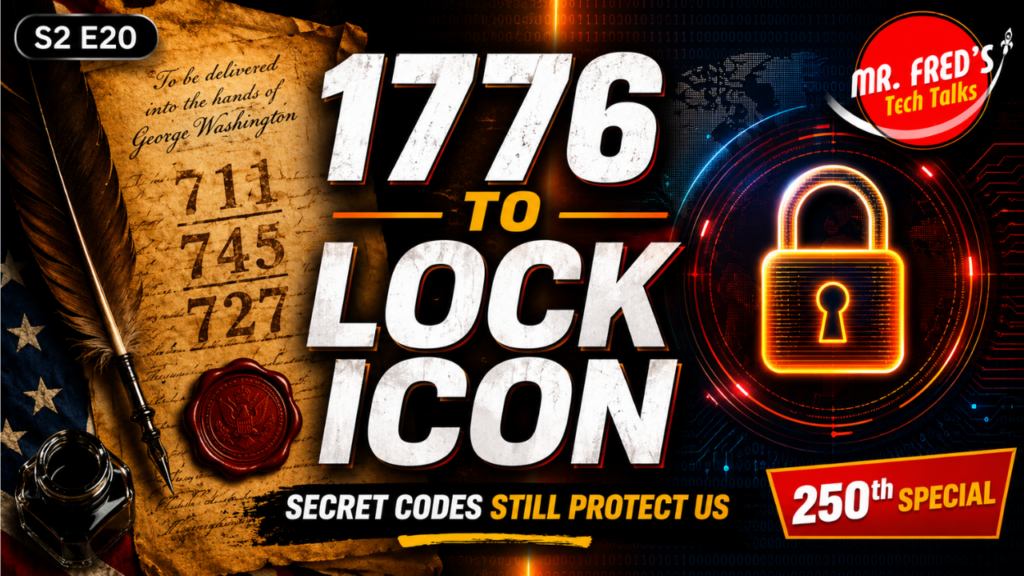
The Founders understood this intuitively. When George Washington ran the Culper Ring spy network out of British-occupied New York, his agents used invisible ink, pre-arranged dead drops, and numerical codebooks to pass intelligence without the British being able to read it. A number like 711 meant George Washington. The word England became 745. Anyone who intercepted the message just saw numbers.
That is the same concept behind the encryption protecting your online banking, your messages, and your passwords today. The math has gotten extraordinarily more complex, but the idea has not changed: scramble the message so that only the right person can read it.
Revolutionary War Spy Craft: The Culper Ring
The Culper Ring was one of the most effective intelligence networks in American history. It operated from roughly 1778 to 1783, based in New York City during the British occupation. Its members were ordinary people: merchants, farmers, and civilians who risked their lives passing information to Washington’s Continental Army.
A few highlights Mr. Fred covers in this episode:
Invisible ink: Washington wrote letters requesting more of it. The chemical compound, developed in part by a man named James Jay, was called sympathetic stain. The writing was invisible until a second chemical was applied, called the reagent. Without the reagent, the message simply did not exist on the page.
Anna Strong’s clothesline: One of the Culper Ring’s members, Anna Strong, used laundry hung on her clothesline to signal other agents about where to pick up messages. A black petticoat meant a meeting was happening. The number of white handkerchiefs indicated which cove along the Long Island Sound to check.
The nomenclator: The Culper Ring used a codebook that assigned numbers to words, names, and places. This is called a nomenclator cipher. Without the shared codebook, the message was gibberish. With it, the message was perfectly readable.
These methods required what cryptographers call a shared key: a piece of information that both the sender and receiver had, and nobody else did. That shared key concept is still the foundation of modern encryption.
From Codebooks to Encryption: The Technology Connection
Modern encryption works on the same foundational principle as the Culper Ring’s codebook. Take readable information, called plaintext, and transform it using a key so that it becomes unreadable ciphertext. Only someone with the right key can reverse the process.
The Caesar cipher: Julius Caesar used this method in ancient Rome, and it is still one of the clearest ways to understand encryption. Every letter in a message gets shifted a set number of positions in the alphabet. Shift by three and A becomes D, B becomes E, and the word CAT becomes FDW. The shift number is the key. Without knowing the key, the message looks like random letters.
Modern encryption: Today’s encryption uses the same concept but with mathematical algorithms instead of alphabet shifts. The keys are not three-letter shifts but numbers with hundreds of digits. The math is so complex that even the most powerful computers would take longer than the age of the universe to crack it through brute force alone.
The lock icon in your browser: When you see a padlock in the address bar, it means your connection is encrypted using a protocol called TLS. Your data is scrambled in transit. Even if someone intercepts it, they see gibberish.
The Part Nobody Tells You: Encryption Is About Trust, Not Just Secrecy
Most people think of encryption as a privacy tool. And it is. But there is a second function that does not get talked about nearly enough.
Encryption also verifies authenticity.
When Washington received a message from the Culper Ring, he needed to know two things. One: nobody else could read it. Two: it actually came from who it claimed to come from and had not been altered on the way.
Modern encryption solves both problems at once. The privacy piece keeps your information from being read in transit. The authenticity piece, handled by something called a digital signature, proves that the message came from a verified source and has not been tampered with.
That is why encryption is the foundation of trust on the internet, not just privacy. Every time you log into a website and see that lock icon, you are being told: this site is who it says it is, and your data is protected in both directions.
Why This Matters Right Now
Encryption sits at the center of some of the most important debates in technology and government right now.
Law enforcement agencies argue that being locked out of encrypted communications makes it harder to stop serious crime and terrorism. Privacy advocates argue that any backdoor into encryption makes everyone less safe, because a backdoor for one is a backdoor for all. Tech companies, courts, and policymakers are still working through it.
There is no easy answer. But here is something worth knowing: these are not new debates. The Founders argued about the same tensions between security, privacy, and the rights of individuals versus the power of government. They built those tensions into the founding documents on purpose.
Understanding encryption gives you a foundation to engage with these conversations. That is exactly what a 250-year-old democracy was designed to need.
Tech Challenge: Try the Caesar Cipher
Here is this episode’s hands-on Tech Challenge, and it is perfect for the Fourth of July.
Step 1: Write a message
Write anything. Keep it short. A sentence or two works perfectly.
Step 2: Encrypt it
Shift every letter in your message forward by three positions in the alphabet. A becomes D. B becomes E. Z wraps around to C. Numbers and punctuation stay the same.
Step 3: Send it
Give the encrypted message to a friend or family member without telling them the key.
Step 4: See if they can crack it
Give them some time. Then reveal the key: shift every letter back by three.
Bonus challenge
Before you start, agree on a different shift number and keep it between just the two of you. Now you have a working shared key encryption system. You are officially doing what the Founders did, just without the invisible ink.
Teachers and parents: this works beautifully as a classroom or family activity. Try having students write encrypted notes to each other and exchange keys separately. It opens up great conversations about privacy, trust, and how information moves.
Final Thought
250 years ago, ordinary people risked their lives to pass coded messages across enemy lines. The technology was invisible ink and hand-copied codebooks. The stakes were the birth of a nation.
Today, the technology is mathematical algorithms and billion-digit keys. The stakes are your bank account, your medical records, your private conversations, and your identity online.
Same idea. Very different scale.
Every time you see that little lock icon, remember: that is the Founders’ instinct, encoded into mathematics.
Keep learning. Keep questioning. And keep building.
Keep Exploring
If you enjoyed this episode, here are a few next steps:
- Explore encryption and cybersecurity topics on the GetMeCoding blog
- Share this episode with a student, parent, or teacher who would enjoy the history connection
- Look up the Culper Ring for a deeper dive into Revolutionary War intelligence, it is a genuinely fascinating story
Technology keeps changing. Curiosity is how we keep up.
Connect with GetMeCoding
Website: https://www.getmecoding.com
Courses: https://courses.getmecoding.com
Podcast: https://www.getmecoding.com/podcast-mr-freds-tech-talks/