EPISODE DESCRIPTION
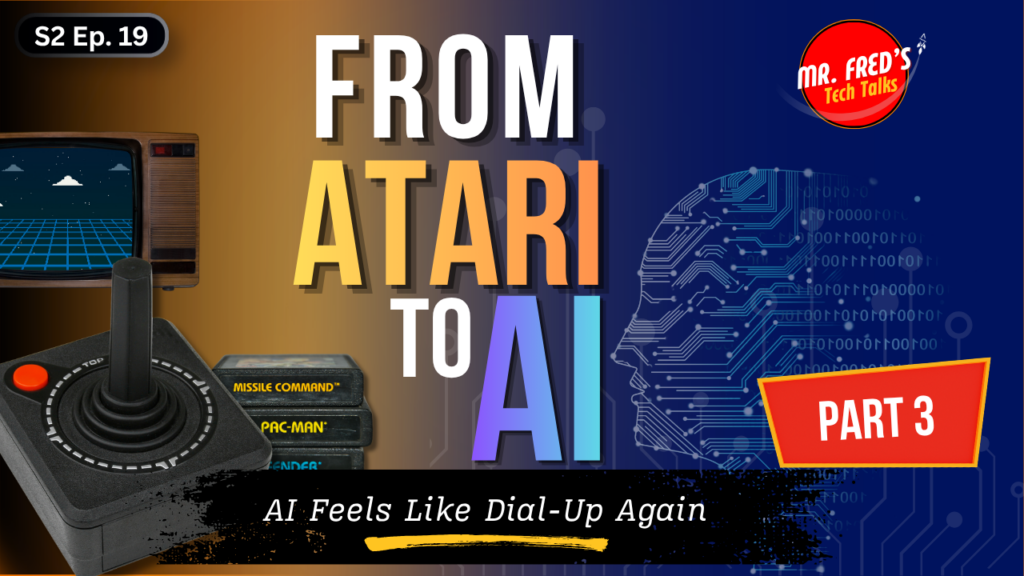
In this third installment of the “From Atari to AI” series, Mr. Fred takes you back to the moment a Commodore 64 and a long telephone cord changed everything. From CompuServe to college computer labs to email in the military, he traces the evolution of connectivity and asks the question that matters most today: when a powerful tool makes things easy, how do we make sure we keep the thinking? If you’ve ever heard a dial-up modem screech or told your family to stay off the phone, this one’s for you.
WHAT YOU’LL LEARN IN THIS EPISODE
- How a Commodore 64 and a wall-mounted kitchen phone became Mr. Fred’s first “connected” computer setup, and why that moment still matters.
- What a modem actually does, explained in plain language so you can explain it to your kids.
- Why the slower, noisier technology of the dial-up era actually made the process more visible, and what we lose when technology becomes invisible and instant.
- The lesson from a young Marine who accidentally emailed the entire Corps, and why it applies directly to AI use today.
- Why technology literacy isn’t one thing, and how parents, teachers, and students each bring valuable skills to the table.
- How to stay curious and engaged with AI without panicking or blindly trusting it.
KEY TAKEAWAYS
New technology arrives before we know what to do with it. From dial-up to AI, the pattern is the same: we explore, we stumble, and slowly we figure out what it’s good for. Patience and curiosity matter more than expertise.
The human still owns the decision. AI can draft, summarize, brainstorm, and help you get unstuck. But it does not remove responsibility. When you hit send, post, or submit, you own that action.
Technology literacy is a collection of skills, not one thing. Knowing how to code is different from knowing how to use a spreadsheet, communicate online responsibly, or evaluate whether information is accurate. All of it matters.
Easy does not mean ready, and fast does not mean correct. Just because AI gives you an answer does not mean you understand the answer. Just because it writes something does not mean it sounds like you. Use the tool, then check the work.
Parents and teachers: you’ve already adapted to technology change before. Dial-up, email, smartphones, GPS, social media. You’ve done this before. You don’t need to know everything about AI to guide kids well. Stay curious and ask “show me what this does.”
RESOURCES MENTIONED
- CompuServe, Prodigy, and AOL: early online services discussed as dial-up context
- WarGames (1983 film): referenced as a visual example of acoustic coupler modems
- IBM PS/2 Model 25: college computer mentioned as a milestone machine
- Commodore 64: central machine of this episode
- GetMeCoding.com: Mr. Fred’s resource hub for families learning tech
CONNECT WITH MR. FRED
Website: GetMeCoding.com