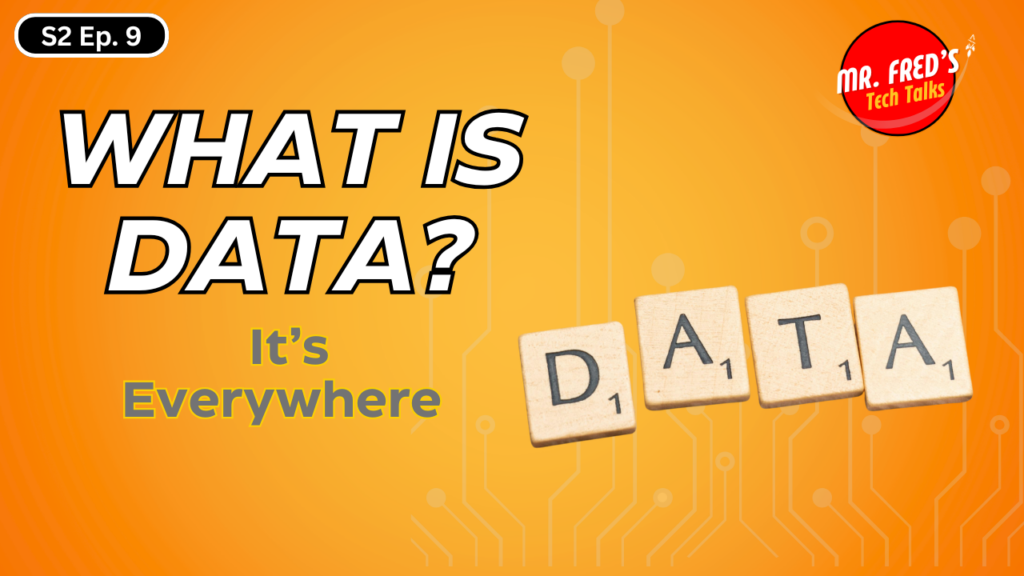
What is data, really?
We hear the word everywhere. Data privacy. Data breaches. Big data. Data-driven decisions. It shows up in headlines, business meetings, school projects, and dinner table conversations.
But if someone asked you to explain what data actually is, could you?
Most people pause at that question. Not because they are not smart, but because the word gets used so much that nobody stops to define it.
In this episode of Mr. Fred’s Tech Talks, we fix that.
We break down what data is in plain language, walk through the types of data you already create every single day, and explain why data is the invisible fuel behind everything from your streaming apps to artificial intelligence.
In This Episode
In this episode, Mr. Fred covers:
- what data actually is, explained without jargon
- why data existed long before computers and what changed
- the types of data you already interact with every day: text, number, image, audio, location, and behavioral
- why behavioral data might be the most powerful and least understood type
- a simple junk drawer analogy that makes raw vs. organized data instantly clear
- why AI does not work without data
- a quick look at how much data a single day in your life produces
- a hands-on Tech Challenge you can try with your family, students, or coworkers
This episode is designed for parents, teachers, students, and anyone who wants to understand the digital world a little better. No technical background required.
The Big Idea
Data is simply information that has been recorded so it can be used later.
A handwritten recipe card is data. A scoreboard at a game is data. A class roster is data. Data has always existed.
What changed is what we can do with it. Once information becomes digital, it can be stored, searched, shared, and combined with other data in ways that were never possible before. That shift is what makes data so central to modern technology.
And if you listened to the last episode about your phone and targeted ads, you already saw this in action. The ad systems that seem to read your mind are not listening to your conversations. They are reading your data.
Types of Data You Already Create
You are surrounded by data every single day. Here are some of the types Mr. Fred breaks down in this episode:
Text data:
Emails, messages, documents, and notes.
Number data:
Bank balances, scores, prices, step counts, and GPAs.
Image and video data:
Photos, videos, thumbnails, and memes.
Audio data:
Music, podcasts, voice memos, and voice assistant interactions.
Location data:
Maps, GPS coordinates, directions, and nearby suggestions.
Behavioral data:
What you click, how long you watch, what you search, and what you almost buy but do not. This type of data is what powers recommendation engines, targeted advertising, and artificial intelligence.
Why Data Matters Right Now
Data is the fuel behind almost every piece of technology you use. Streaming services recommend shows based on viewing data. GPS finds routes based on traffic data. Email filters spam based on pattern data. And AI? AI does not work without data.
Mr. Fred recently gave a keynote at an AI Summit and shared this framework: AI helps people create, analyze, and automate. But all three depend on data. Without data, AI is an engine with no fuel.
Understanding data is not just a technical skill. It is a thinking skill. And it starts with knowing the basics.
Tech Challenge: Your Data Day Audit
Here is this episode’s hands-on Tech Challenge:
Step 1: Pick one day this week.
Choose any single day to be your official data tracking day.
Step 2: Write down every piece of data you create or encounter.
From the moment you wake up until the moment you go to sleep, keep a running list. Every time you interact with technology, note what kind of data was involved.
Step 3: Count it up.
At the end of the day, see how many data interactions you logged. It will be more than you expect.
Step 4: Talk about it.
Share your results with a friend, student, family member, or coworker. Ask them how much data they think they create in a day and compare.
Bonus for teachers and parents:
This makes a great classroom or family activity. Have students do the audit and present their findings. It connects directly to topics like privacy, AI, cybersecurity, and digital citizenship.
Final Thought
Data is not complicated. It is just recorded information. But it is also the foundation of everything in the digital world. And now that you understand it, the next topics, databases, AI, privacy, all start to click into place.
That is what we do here at GetMeCoding. Not just using technology, but understanding it. Because understanding is what gives you control.
Keep Exploring
If you enjoyed this episode, here are a few next steps:
- Listen to more episodes of Mr. Fred’s Tech Talks
- Explore beginner-friendly technology insights on the GetMeCoding blog
- Share this episode with someone who wants to understand the digital world a little better
Technology keeps changing. Curiosity is how we keep up.
Connect with GetMeCoding
Website: https://www.getmecoding.com
Courses: https://courses.getmecoding.com
Podcast: https://www.getmecoding.com/podcast-mr-freds-tech-talks/