New to artificial intelligence? This episode continues Mr. Fred’s approachable series about AI, how it works, and how families and educators can use it thoughtfully. After listening, explore the complete five-part AI series below.
Pencils? Check. Notebooks? Check. Four mysteriously specific black pens? Check.
But as students prepare for another school year, artificial intelligence is changing what it means to be ready for the classroom. AI can explain a lesson, generate ideas, solve problems, and complete an assignment in minutes. That leaves parents, teachers, and students with an important question: Did AI help the student learn, or did it quietly help them skip the learning altogether?
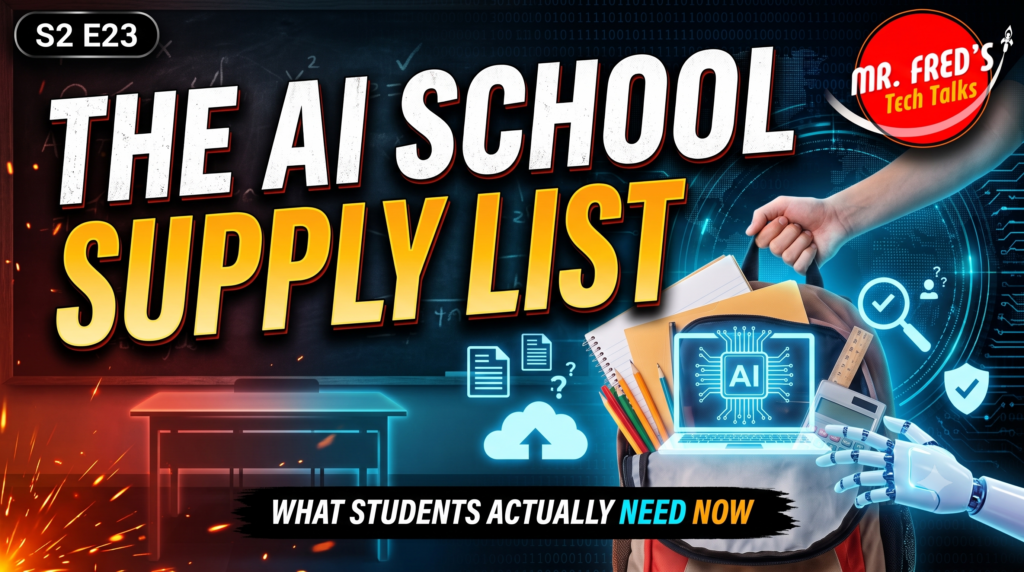
In this episode of Mr. Fred’s Tech Talks, I pack three essential skills into the AI-age school backpack.
The school-supply list has changed
When I was growing up, being technologically prepared for school might have meant carrying a calculator. As I shared in the podcast here are my calculators that got me through high- school and college. (Note: yes, we were allowed a note card in physics!)

Teachers often warned us that we needed to learn the work ourselves because we would not always have a calculator available. Today, students carry powerful computers in their pockets, complete assignments online, collaborate in shared documents, and communicate through email and learning management systems. Now, they also have AI.
But being comfortable with technology is not always the same as being capable with it. A student might know how to master a game or create a video, but still struggle to locate a downloaded file, submit an assignment in the correct format, or write a clear email to a teacher.
The modern school-supply list is not simply about owning more technology. It is about developing the habits needed to use technology effectively.
Supply number one: Digital confidence
Digital confidence is not just knowing how to scroll, swipe, or install an app. It is the willingness to pause, examine a problem, and try to understand what is happening.
Students should be able to ask:
- Where was the file saved?
- Is it on the device or in the cloud?
- What does the error message actually say?
- Was the correct document uploaded?
- Can the teacher open it?
- How can I clearly explain the problem when asking for help?
AI can help explain error messages, suggest troubleshooting steps, and improve an email. However, it should polish a student’s voice without replacing it with the voice of an international diplomat. Digital confidence does not mean knowing everything. It means being willing to investigate before panic takes over.
Supply number two: Healthy skepticism
For years, we have told students not to believe everything they read on the internet. Now we should add: Do not automatically believe everything the internet says back to you.
Generative AI can simplify a difficult idea, create practice questions, review writing, and present information in several ways until something finally clicks. It can also be wrong with remarkable confidence. Getting an answer is now incredibly easy. Determining whether the answer is trustworthy is where the real work begins. Students should learn to ask:
- Where did this information come from?
- Can it be confirmed?
- Is the information current?
- Do the cited sources exist?
- Do those sources support the claims being made?
Healthy skepticism does not mean assuming everything is false. It means leaving a little space between seeing something and believing it. That thoughtful pause may be one of the most valuable supplies in the digital backpack.
Supply number three: Knowing when AI helps
The most important question may no longer be: Did the student use AI?
A more useful question is: Did using AI leave the student understanding more than when they started? AI can remove unnecessary frustration by providing a hint, offering a clearer explanation, or helping a student begin. However, some struggle remains an important part of learning. Working through a math problem, revising a paragraph, debugging a program, and trying to remember something before looking it up are all forms of productive effort. I compare AI to a spotter at the gym. A good spotter keeps you safe, helps when you are stuck, and encourages you through the difficult part. The spotter does not lift every weight while you stand nearby and then congratulate you on your tremendous workout.
AI can either replace thinking or encourage more of it. Instead of asking AI to write an essay, a student could say: Ask me questions that will help me decide what I think about this topic.
Instead of asking it to solve a problem: Give me one hint without revealing the answer.
A student learning to code might try: Here is the code I wrote. Ask me questions that will help me locate the error.
The goal is to make AI behave less like an answer machine and more like a coach.
A better conversation about student AI use
Parents and teachers do not need to master every AI tool before talking with young people about them. The tools will continue to change faster than most of us can learn their names. A better conversation can begin with three simple words: Show me how.
Ask students to show which ideas were theirs, where AI helped, what they questioned, and whether they checked the results. Teachers can also ask: Tell me how you arrived at this.
These questions focus the conversation on reasoning and learning, instead of relying on an AI detection score.
Mr. Fred’s Tech Challenge
This week, use an AI tool with one important restriction:
It cannot give you the final answer.
Choose something you genuinely want to understand. It could be a math concept, a coding problem, a historical event, a science question, or even how sunscreen protects your skin.
Give the AI this prompt:
I am trying to understand [insert topic]. Do not give me the final answer. Ask me questions, provide clues, and help me work it out for myself.
Parents can try this with their children. Teachers can test it with students. Students can compare this coaching approach with simply asking AI to complete the task.
Then ask:
- Which approach made me think more?
- Which one helped me understand more?
- Which one am I more likely to remember?
- What changed when AI became a coach instead of an answer machine?
If you try the challenge, share what happened with GetMeCoding on Facebook or Instagram at @getmecoding.
Listen to the episode
Listen to “The AI School Supply List: What Students Actually Need Now” on your favorite podcast platform or through the GetMeCoding YouTube channel.
You can also explore previous episodes that explain artificial intelligence in approachable, everyday language:
What is Vibe Coding? https://www.getmecoding.com/what-is-vibe-coding/
If this episode made you think, please share it with a parent, teacher, or student preparing for the new school year.
AI can help carry a few supplies.
Just don’t let it carry the whole backpack.